Dog Hair Dont Care Script Paw Prints
First Impression: Playful, Confident, and Instantly Relatable
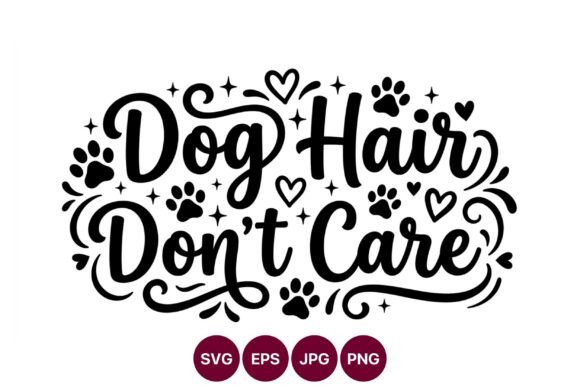
When I opened the Dog Hair Dont Care Script Paw Prints file, I smiled—not because it’s “cute,” but because it feels like a real person wrote it on a coffee-stained napkin and then handed it to me with a wink. The black script is loose but legible, with gentle swells and tapered ends that suggest hand-drawn charm rather than rigid vector perfection. Paw prints flank the phrase asymmetrically—some upright, some tilted—while tiny hearts and delicate swirls nestle into negative space like afterthoughts that somehow hold the whole composition together. It’s not overly busy, but it’s never flat. That balance matters most when translating illustration into stitch.
A Real-World Test: Embroidering It on a Linen-Cotton Tote Bag
Last week, I used Dog Hair Dont Care Script Paw Prints for a custom tote bag order—a gift for a new dog mom launching her own pet-sitting side hustle. She wanted something warm, unpretentious, and unmistakably *her*. We chose natural linen-cotton blend fabric, medium-weight tear-away stabilizer, and matte black thread. The result? A relaxed, tactile finish where the script softened just enough in satin stitch, and the paw prints held crisp definition without looking stiff. Customers at her first craft fair paused, chuckled, and said, “That’s *so* me.” That kind of emotional resonance isn’t accidental—it’s built into how the design breathes on fabric.
Where It Shines (and Where It Needs Thought)
Dog Hair Dont Care Script Paw Prints excels in projects where personality outweighs precision: embroidered sweatshirt cuffs, baby onesie hems, apron pockets, pillow covers for dog-loving grandparents, or tea towels for a cozy kitchen boutique. Its moderate scale and open letter spacing translate well to fill stitch and running stitch combos—no dense satin overkill needed. As an embroidery file, it’s forgiving on textured fabrics like terry cloth or bouclé, and the paw prints read clearly even at 3–4 inches wide.
But here’s what I watched closely: the smallest hearts and inner swirls. On a curved cap front or a stretchy cotton jersey tee, those fine decorative accents risk blurring or disappearing entirely unless you adjust stitch density and use cut-away stabilizer. Likewise, on dark fabric, the black script loses contrast unless you add a subtle white underlay—or switch to charcoal gray thread for softer depth. And while it works beautifully as a standalone embroidered patch, avoid placing it near seams or high-flex zones (like elbow patches) without reinforcing the back with fusible web.
Design Integrity Meets Commercial Reality
This isn’t just decoration—it’s brand language in thread. When used thoughtfully, Dog Hair Dont Care Script Paw Prints elevates a handmade product from “nice” to “I need this in my life.” For Etsy sellers, it adds instant recognition to listings—especially paired with clean, lifestyle-focused mockups. For small shop owners curating holiday embroidery bundles, it fits seamlessly alongside bone-shaped ornaments or “Paw Patrol Approved” baby blankets. But its strength lies in authenticity: it doesn’t try to be elegant or minimalist. It’s joyful, slightly irreverent, and rooted in real-life pet ownership.
That authenticity builds customer trust. Buyers don’t just buy a phrase—they buy shared experience. Which means if you’re using Dog Hair Dont Care Script Paw Prints for commercial embroidery, make sure your finished product reflects that same honesty: tidy stitching, consistent thread tension, and thoughtful placement. A sloppy execution undermines the design’s charm faster than a tangled bobbin.
Practical Designer Notes Before You Stitch
- Always test first: Run a sample on scrap fabric matching your final substrate—especially if using knits, fleece, or textured weaves.
- Check thread color contrast: Black-on-white reads cleanly, but black-on-charcoal or navy needs a slight underlay or tone-shifted thread.
- Review stitch density: The swirls and hearts may benefit from reduced density (10–15% less than main script) to prevent puckering on lightweight fabrics.
- Confirm hoop size and placement: At full scale, this design fits comfortably in a 5×7 hoop—but if resizing down for a cap or baby bib, verify legibility of the smallest paw print details.
- Inspect corners and curves: Running stitch outlines around swirls should flow smoothly; if your machine hesitates, simplify paths before converting to machine embroidery design format.
- Mock it in context: Drop the PNG into a printable mockup of your intended product (tote, sweatshirt, pillow cover) and view it at actual size—both in color and grayscale—to assess visual weight.
- Licensing check: Since this is listed as Graphics within Illustrations, confirm whether the download grants commercial rights for finished goods and digital resale—especially if bundling it into embroidery kits or design assets for other makers.
Final Thought: A Design That Earns Its Place
Dog Hair Dont Care Script Paw Prints isn’t flashy—but it’s memorable. It doesn’t shout; it winks. And in a market saturated with overdesigned, overdigitized motifs, that quiet confidence is rare. Whether you’re stitching it onto a holiday gift for your sister’s golden retriever or building a cohesive line of dog-themed merchandise for your craft business, this design earns its place by feeling human first, decorative second. Just remember: great embroidery isn’t about perfect files—it’s about choosing the right one for the story you’re stitching.